


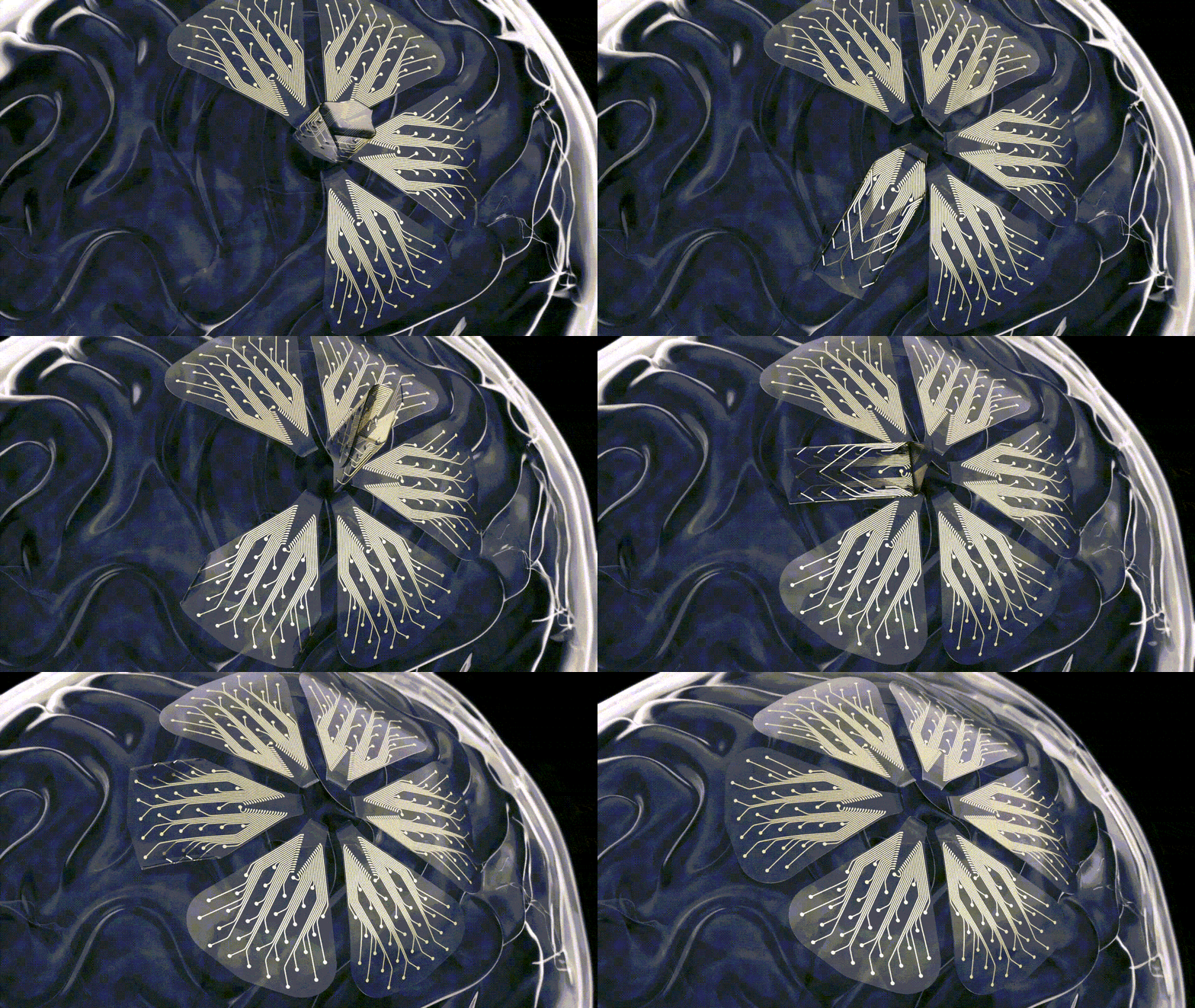
Neurosoft Bioelectronics is a neurotech firm from Geneva, Switzerland engineering implanted BCIs to restore quality of life to patients with neurological conditions like tinnitus and motor disability. They’ve pioneered ultra-compliant electrode arrays that fold for minimally-invasive deployment and stretch to conform to the surface of the cortex, along with a versatile manufacturing process that allows for a range of electrode designs and dimensions, and neural decoding models for improved biomarker detection, neuromodulation, and motor intention decoding.
Neurosoft has shown impressive growth since their founding in 2020, most recently closing a $7.5 million oversubscribed seed round in May. In February, they announced a partnership with implantable BCI firm Science Corp to utilize the Silicon Valley group’s full stack of clinical-grade neural recording tools. Right before closing their seed round, they won a grant from the Swiss AI Initiative to access the globally-ranked, hydro-powered supercomputer Alps, which they’ll use to accelerate the training of their neural decoding models.
This spring, Neurosoft opened a second office in New York. We reached out to their co-founder and CEO, Nicolas Vachicouras, for an interview about the recent move, their headlines from earlier this year, and developments to look forward to from the group. Below is a transcript of our conversation, edited for clarity.
Hey Nicolas, thanks for taking the time to talk.
What prompted Neurosoft’s move to New York? Are there any exciting collaborations you’re planning or resources you hope to tap in New York in the future?
We’re based in Switzerland, and we wanted to have an office and a presence in the US, because it’s our first market in terms of regulatory pathway. From a fundraising perspective, I also feel like there’s more capital and more willingness to invest in this field versus in Europe, which is a bit more risk-averse.
This is the general explanation for having a presence in the US, but we really needed to have a presence in New York for a few other reasons. First of all, convenience in terms of time zones, because we still have a large team in Geneva, Switzerland, and we wanted to make sure the US and Swiss teams could work closely enough, because a 9-hour time difference with California can be harder to manage. And more importantly, I really feel like there is a growing ecosystem here in New York. If we look at implantable BCI companies, there are not that many compared to non-invasive BCI startups, but two of them, Synchron and Precision, are here in New York. So for us, it made a lot of sense. Then if you look at the broader neurotech field, there’s Kampto Neurotech, OpenBCI, and Meta Reality Labs here in New York, and in general, if we look at the broader coast, between here, Connecticut, and Boston, with companies like Axoft or Neurable, it’s overall a good place to be.
There are also good incentives from the state of New York. We are currently talking with them to see how we can leverage that. I feel like there’s a large push to try to attract life science companies beyond neurotech. And by talking to some of our investors, there seems to be more neurotech companies starting here in New York. So I feel like it’s an overall good location.
Finally, we also see a very strong pool of talent, and very good hospitals here with Mount Sinai, Langone, and others. That’s also very important to us.
New York State, and City, have put a lot of effort into growing the life sciences and tech scenes here. I’m reminded of EmpireAI, the state’s AI initiative that operates a supercomputer in Buffalo, because of the supercomputer you’re using through the Swiss AI initiative to train your neural decoding models.
Do you feel Neurosoft is ahead of the curve on neuroAI? Do you imagine being leaders in that field?
I wouldn’t say we’re ahead of the neuroAI curve now, but that’s definitely our objective: to be able to lead this field thanks to our scalable brain interface. There’s a lot of neuroAI happening in the non-invasive space, but there is still a lot to be done on the implantable side. The main bottleneck there is a huge lack of high-quality brain data, which we believe we can solve with our technology. This is actually one of the things we want to develop in New York, as we’re starting to gather more data.
Are you seeking more machine learning engineers and researchers here in New York? And if so, are you finding there to be a good applicant pool here?
We made our first hire recently, Florence Lee, who is a senior embedded systems engineer here. As you might have seen, we are collaborating with Science Corp, based in California, and she is helping with the hardware integration of Science components with our brain interfaces built in Switzerland. And indeed, one of our open positions is on the ML/AI side, and we plan to grow that team even more in the future. We believe there’s an overall strong pool of talent for both hardware and software engineers, in both neurotech (thanks to Precision and Synchron), and more broadly in AI, with strong universities here.
Why did you choose New York over a city like Boston, where the universities, hospitals, and life sciences ecosystem are comparable?
People always ask me: ‘why not Boston?’. They understand why we chose the East Coast, but not why New York versus Boston. I feel like Boston has really been more in biotech and less so in neurotechnology. It’s only recently in the past few years that there have been spinoffs from MIT and Harvard in neurotech. Before then, I feel like the big hubs were really mostly in New York, Texas, and California.
How do you find the East Coast compares culturally with those hubs, and Europe?
When I think of investors, I always talk about this gradient, where you have on one extreme the risk-averse Europeans, then you have the East Coast, and then you have the very ambitious West Coast.
I give this example when people ask me the difference between California and Europe: I was pitching one day to a Swiss-German investor in the morning, and he was asking me what our revenue will be two years from now. That afternoon, I was talking to someone in San Francisco, asking me if in twenty years, they could drive their Tesla with their brain. So that tells you everything you need to know.
I really like Europe. I think there’s a great environment, great innovation, and really, really good talent. But when I think about why there’s still this big difference around risk perception and ambition, I believe it’s a mentality issue more than anything.
Do you think that gradient is the same for the public perception of neurotech — do you find people themselves are less receptive of neurotech in Europe?
For sure. My co-founder was in California a few months ago and told me, “I was stopped at a red light, and every car waiting there had no driver.” You won’t see that in Switzerland yet. In general, Europeans tend to view advanced technologies through the lens of risk: focusing more on the negatives than the positives, when there are always both. In the US, the emphasis falls on the positives. There are exceptions, of course: I’ve met great people who embrace risk in Europe and Switzerland. Our lead investor is a great example: they are European, even though their founder grew his company in the US before coming back, so he’s heavily US-minded. But yes, I see this gradient across regulation, public perception, and funding alike.
Speaking of the West Coast, are you excited to be working with Science Corp, a group in the heart of things in Silicon Valley?
Yes, for sure. I have known Max Hodak for many years now and have followed his work at Science Corp, and it’s one of these companies where I really believe in the technologies they’re building. There are different approaches and technologies to building BCIs, and in particular the backend electronics required for a fully implantable system, and Science Corp are working on the right technology stack and form factors that I would have explored if I had the same amount of money as they have.
And then their team is really excellent. We are really happy with the people we’re working with there. So yes, definitely exciting. And, finally, Max helped me a lot to understand the difference between the US investor mindset, versus European ones. For me, it was a big clash. When I started pitching to California investors, I thought we were speaking a different language. So it was helpful.
I noticed the parallels between Neurosoft’s approach and Science Corp’s — it seems, just in watching interviews of Max, that he cares deeply about creative and feasible solutions to bio-integration, for example. Are you actively working with Science day-to-day?
Yes, our R&D team has regular meetings with them and daily email exchanges. We are really working hand-in-hand together to combine technologies.
On the note of Silicon Valley, some frontier AI labs recently opened up here in New York City. Do you see any future neuroAI collaborations happening here?
Yes. We recently announced our VP of Neuro AI hire, who is putting in place our AI strategy, and part of it is to set up collaborations with either researchers or companies who are actively in the neuroAI field, if we think that there are synergies. I cannot tell you any names for now, but we are definitely interested in collaboration in that area.
NeuroAI is something that NeuroNYC is very interested in covering and being an active part of. I think I had seen you say in a past interview that BCI and AI are becoming one and the same, that to be ahead in one is to be ahead in the other.
I know there’s a big hype around AI in general, but historically AI has always played a very important role for BCIs, in helping decode brain activity. And there is also a lot of interest in both directions: not only how AI can improve neurotech, but also the opposite: how what we learn from the brain can help improve AI. This loop is super interesting from a broader perspective, and I am also personally interested in how these tools can help us better understand biological intelligence and cognition.
Thanks Nicolas! Really appreciate the time.
Appreciate it, and thanks for reaching out.