


Neurotechnology is young, awaiting breakthroughs and trial clearances before it sees widespread adoption in clinics and homes. New York’s neurotech ecosystem is young as a result. But like the strong local life sciences and tech industries from which it grows, we believe the metro region’s neurotech ecosystem is well positioned to lead the country. Here we’ll unpack the infrastructure that could support a dominant neurotech industry.
Across the five boroughs, Long Island, the Hudson Valley, northern New Jersey, and western Connecticut, the metro region is home to more than 5,000 life sciences businesses, the most of any U.S. metro region, leading the Boston region by 30%. Key players include universities like NYU, Columbia, Rockefeller University, Rutgers, Princeton, Yale, and the CUNYs, hospitals like NYU Langone, New York-Presbyterian Weill Cornell, Mt. Sinai, Montefiore Einstein, and Northwell Health, and institutions like the New York Genome Center, the New York State Psychiatric Institute, and the Nathan Kline Institute. Together, these groups received $3.3 billion in NIH funding in 2024, the most federal funding given to life sciences groups in any U.S. metro region. The region is also home to major life sciences companies like Pfizer, Regeneron, Johnson & Johnson, Roivant, Axsome Therapeutics, and Bristol-Myers Squibb.
Despite a density of talent in the region, New York City’s life sciences startup ecosystem is just starting up. Back in 2014, New York City life sciences startups raised only $50 million in venture capital (VC) funding. Two years later, recognizing economic potential, the city announced LifeSci NYC, a $1 billion commitment to life sciences in the five boroughs. The initiative has focused on increasing square footage of lab space for startups and providing resources to accelerate growth. In 2018, Johnson & Johnson opened JLABS @ NYC in SoHo, a life sciences startup incubator, with help from the city; in 2022, the city cut the ribbon on the Taystee Building in West Harlem, providing lab space for life sciences research groups like Harlem Biospace and a CCNY startup incubator; in 2023, the city committed to build SPARC Kips Bay, a development five times the square footage of the Taystee Building, which will provide more parceled lab space, along with space for New York state and city schools. Besides infrastructure, the city has promoted innovation with credit and resources: in 2018, LifeSci NYC introduced an expansion fund to provide loans and guidance to Seed and Series A life sciences startups; in 2022, the city introduced a yearly Founder Fellowship; in 2023, then-Mayor Eric Adams passed a biotech tax credit designed to benefit early-stage biotech startups.
The city’s life sciences startups responded, and VCs got the memo. A decade later, New York City life sciences startups raised $1.8 billion — 25 times their 2014 total, adjusted for inflation. $2 billion was raised by life sciences startups across the greater metro region that year, the fourth-most among U.S. metro regions. To the city, its investments have been a success, seeing the metro region’s life sciences economic output compound 8% annually from 2014 to 2024, leading the city’s total rate of 2% over that time. The life sciences sector saw a 70.9% GDP growth from 2019 to 2024, doubling that of Finance & Insurance.

The strength of the local life sciences industry and the growth of its startup ecosystem are good proxies for expected growth of many of the most valuable neurotech firms to come: those developing clinical and implanted neurotech, who will draw on much of the same research talent pool as pharma and biotech firms, and whose products will require the same investor resilience to FDA hurdles and extended timelines to revenue. As expected, such neurotech firms have participated in the growth: Synchron, which places a stent electrode in an artery of the brain for computer interfacing, was incorporated in 2016 in Brooklyn and recently reached a $1 billion valuation with a Series D fundraiser of $345 million; Precision Neuroscience, which places electrodes under the scalp for computer interfacing, was founded in Manhattan in 2021 and has raised $155 million in four rounds of funding since.
But for neurotech companies that are not implanting devices or promising medical benefits — imagine Õura using neural data to generate health suggestions, or a company building software and hardware for other neurotech groups — the health of the local tech sector is another good proxy for estimated growth. And, like the life sciences, the local tech startup ecosystem has come into form relatively recently. Recognizing a lag behind other cities’ tech economies in the early 2010s, the city led initiatives to bolster local tech: in 2008, the city started NYC Seed, a VC firm which invested in seed-stage tech startups until 2015, and in 2010 the city gave $100 million to Cornell University to help build Cornell Tech, a graduate tech campus and startup incubator, on Roosevelt Island, which spurred NYU and Columbia to found data science graduate programs soon after. In 2010 Google moved into Chelsea, and in 2012 Facebook opened its first engineering operation beyond the West Coast in Midtown.
These developments brought New York tech up to speed, and by the 2020s it was ready for the A.I. boom, as the percentage of the city’s total VC investments going to local tech startups from 2019 to 2024 grew from 37.6% to 52.4% while the sector saw 54.2% GDP growth, and 35 A.I.-related local startups have reached $1 billion valuations. Those non-implanted, non-clinical neurotech startups saw growth in the same years: CTRL Labs, which uses wrist-based motor signal electrodes for device control, was founded in Midtown in 2015 and then acquired by Meta in 2019 for up to $1 billion (Meta subsequently opened their first New York-based Reality Labs office in its place); Synaptrix Labs, which uses wearable electrodes for computer interfacing, was founded in Manhattan in 2023 and secured up to $10 million in seed funding from Mark Cuban Companies just one year later.
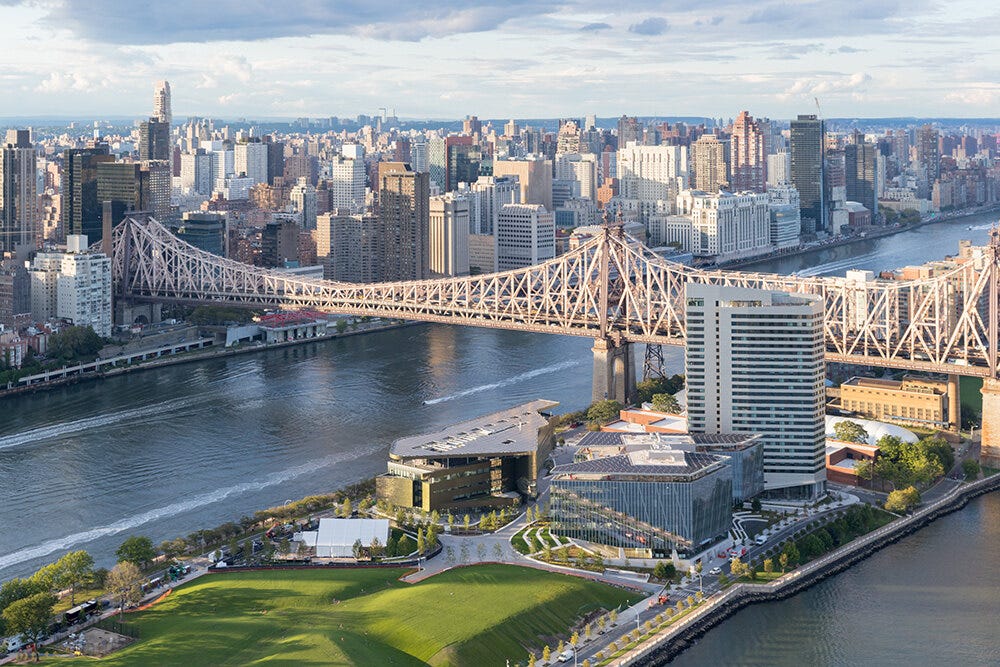
In an environment where world-class scientists and engineers are trained around every corner, startup infrastructure and acceleration have become a public priority, and VCs continue to invest more heavily into life sciences and tech, the New York metro region is well positioned to lead neurotech innovation in coming years.
From Montreal. That’s where we hold the future of general intelligence